
Your report says belly. Or low spot, or sag, or water level sag. Somebody has probably used the word “settling” and you have started doing sums.
Here’s the part nobody tells you: a belly being written down in a report is not the same as a belly being a problem. There is a long way between the two, and most bellies live in that gap.
What a belly actually is
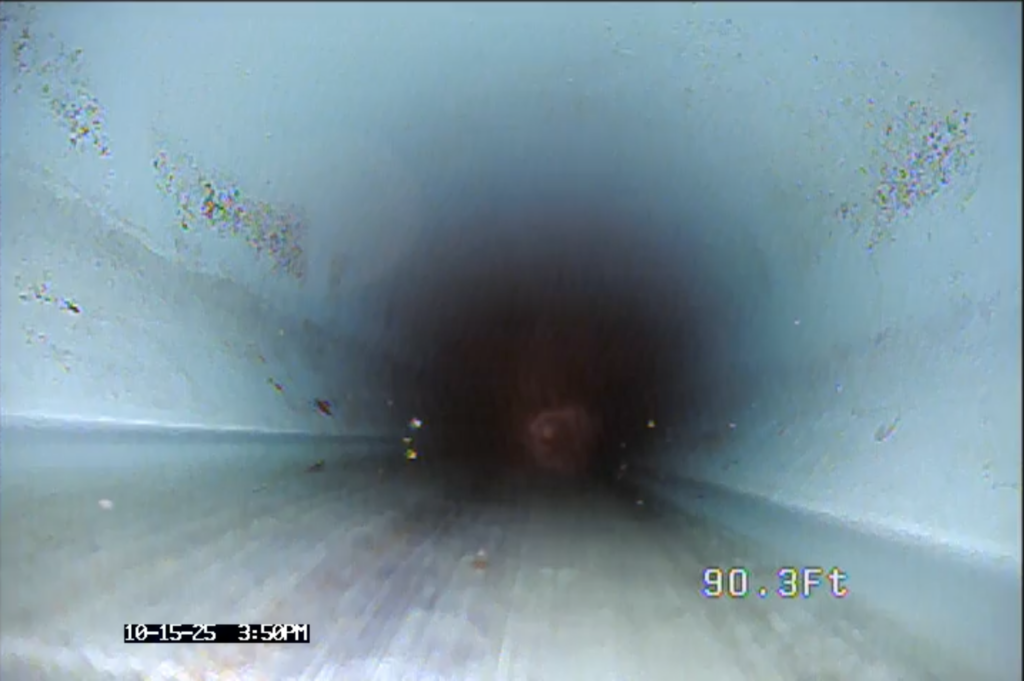
A stretch of pipe that has settled lower than the pipe either side of it. Water reaches the dip, stops running, and sits there.
That’s it. No break, no crack, no missing pipe. The line is intact — it just isn’t as level as the day it went in.
Why nearly every old house in Denver has one
Colorado sits on expansive clay. The Colorado Geological Survey puts it plainly: most of the homes, schools and roads in this state are built on potentially expansive clay soil, and the damage it causes every year runs higher than tornadoes, floods, earthquakes and hurricanes put together.
Bentonite clay swells when it gets wet and shrinks back when it dries. Our climate is dry with seasonal soakings, which is the worst possible combination — the ground under your house moves up and down every year.
Your sewer line is buried in that. A clay pipe laid in 1955 has been riding eighty years of that movement. Of course there’s a dip in it. There’s a dip in everybody’s.
Recorded at 10%. A problem at 50%.
This is the whole page in two numbers.
Under the national inspection standard, a sag gets recorded once the standing water reaches 10% of the pipe’s height at its deepest. Below that it isn’t even a reportable condition. At 10% it goes in the report — because the standard says to write it down, not because anything is wrong.
Our working rule, after twenty-eight years of looking at these:
A belly is a defect when it runs more than twenty feet long and holds more than two inches of standing water — which in a four-inch line is half the pipe or 50%.
Twenty feet and half the pipe. Both, not either.
So a report saying “belly at 45 feet, 20% water” has correctly recorded something that is, on our reckoning, a maintenance item and not a defect. A report saying “sag from 30 to 58 feet, 50%” is describing a real problem. Same word. Completely different situations. The number is what separates them, which is why a report without numbers isn’t much use to you.
What cleaning does, and what it doesn’t
We’ll be straight with you, because this is where people get sold things.
Cleaning does not remove a belly. Nothing does, short of digging the pipe up and relaying it. Anyone who implies a cleaning will take the dip out of your line is either confused or selling.
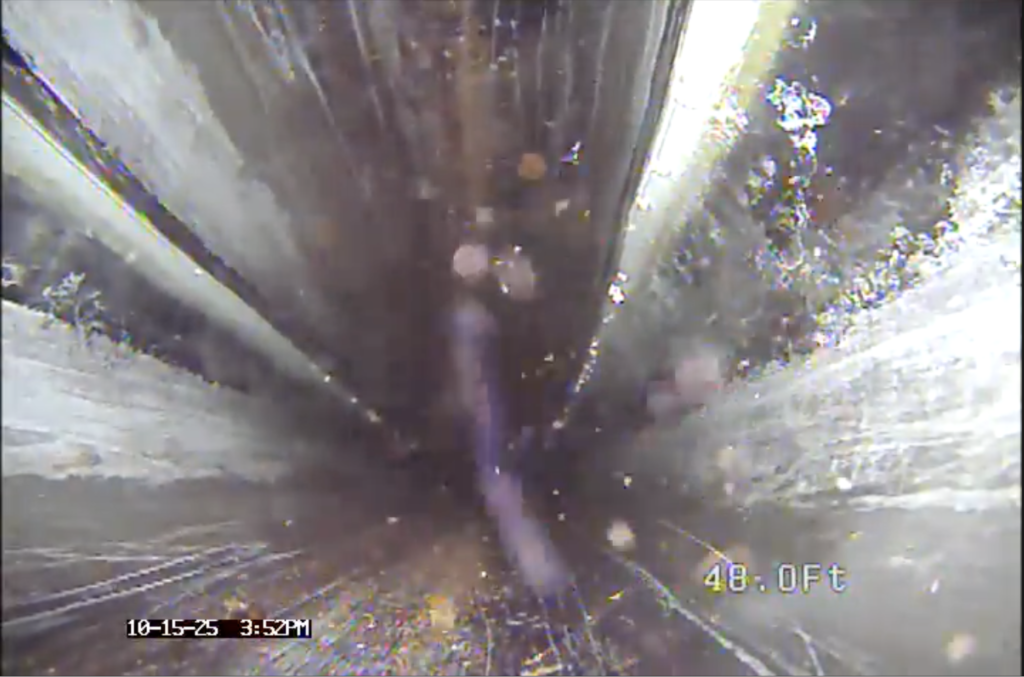
What cleaning removes is what collects in it. Standing water is where paper, grease and solids settle out, because there’s no flow to carry them on. Clear that out on a sensible cycle and a bellied line runs perfectly well for decades. The dip stays. The blockage doesn’t.
That’s the honest version: a belly is a reason to clean the line periodically, not a reason to replace it.
When a belly genuinely is a problem
Past the twenty-foot, half-pipe mark, the maths changes. The dip is now long enough and deep enough that solids don’t just settle — they stay. You get backups that come round again a few months after every cleaning, and the interval keeps shortening.
When that’s what you’ve got, we will tell you. And we can’t fix it — a belly is corrected by excavating and relaying that section to grade, which means digging, which we don’t do.
So we’ll show you on camera, explain what you’re looking at, and point you to R.C Pipeline (303-597-8396), who do underground sewer repair and replacement. BBB accredited, A+ rated. We take no referral fee — the moment money changes hands for a recommendation, the recommendation is worth nothing.
Why you can believe us either way
We don’t do repairs. We don’t dig. We clean, jet, mill and inspect, and that’s the whole list.
So when we say your belly is fine, we aren’t turning down a repair we could have sold — there was never one to sell. And when we say it isn’t fine, we’re sending the work to somebody else and getting nothing for it.
Both answers cost us the same. That’s the point.
If you’re buying a house with a belly in the line
Three questions worth asking before anybody negotiates anything:
- How long is it and how deep? If the report doesn’t give you a footage range and a percentage, it hasn’t told you anything. Ask for both.
- Was the line cleaned before it was scoped? A camera can’t see pipe through debris, and debris gathers in exactly the low spots. Half of what gets called a belly is a belly plus everything sitting in it.
- Has it actually backed up? A twenty-year-old belly that has never caused a problem is telling you something a report can’t.
We’re NASSCO certified, so if you want the line cleaned and scoped properly before you decide, you get a written report and video that lenders, title companies and the other side’s agent will accept — and the footage is yours to keep, permanently.
Agents: there’s more for you on the realtors page.
The rest of the report
- What your sewer inspection report actually means — roots, scale, cast iron, Orangeburg, and what genuinely does mean replacement
- Offsets — the word that sells the most unnecessary replacements in Colorado, with camera footage of a real one and of a joint that just looks like one
- Cracked, broken or collapsed? — four words, four meanings, and which ones require a number
Bring us your report
Call and read it to us. Cam answers the phone and will get you to the right person. Estimates are free, our prices are published, and there’s no trip charge in metro Denver or Aurora.
Family owned and operated, and run on one rule: “Do unto others as you would have them do unto you“. That’s why we’ll tell you when you don’t need the work.
Mon–Fri 8:00am–5:00pm. Free estimates across the Denver metro area.