You have a sewer inspection report in front of you. It’s full of words nobody explained — belly, offset, scale, choked down, corrosion — and a recommendation at the bottom that may or may not be telling you your line is finished.
Here’s what those words actually mean, in plain English, from people who look down these lines every day.
We don’t do repairs and we don’t dig. We can’t sell you a sewer line replacement, so we have no reason to make any of this sound worse than it is — and no reason to talk you out of it if it’s real.
Before anything else: a dirty line can’t be judged
This is the single most important thing on this page.
A camera can only see what isn’t covered. If a line is full of scale, grease, roots and debris, the inspector is looking at the debris — not at your pipe. A great deal of what looks alarming on a first inspection turns out to be the buildup, and the pipe underneath it is sound.
That’s why “clean the line and camera it again” is such a common recommendation. It isn’t a stall and it isn’t a euphemism for bad news. It’s the only honest way to see what you actually have.
Belly, low spot, sag
The word that frightens people most, and usually the least urgent thing in the report.
A belly is a stretch of pipe that has settled lower than the pipe either side of it, so water stands there instead of running through. Colorado’s expansive clay soil moves, and pipe laid in it moves with it. Bellies are common here and most houses of a certain age have one.
Standing water is not a failure. A belly holding half an inch of water is a place where debris gathers, which is a maintenance matter — you clean it out on a cycle and the line runs fine for decades. Cleaning doesn’t remove the sag; nothing short of digging does. It removes what collects in it, which is the part that actually blocks your drain.
A belly becomes a genuine problem when it’s deep enough and long enough to hold solids consistently — and that’s something you can see on camera after the line has been cleaned, not before.
There’s a number that decides whether a belly is a defect, and a lower one that decides whether it even gets written down. How long and how deep a belly has to be before it actually matters →
Roots
Roots come in at the joints. They don’t grow through solid pipe wall. Finding roots in a clay line tells you the line is old, not that it’s broken.
They’re cut out mechanically, and they come back — every twelve to twenty-four months is normal for a clay line with mature trees over it. That’s maintenance, the same as a furnace filter. It is not a reason to replace a functioning sewer line.
Scale, scum, corrosion, “choked down”
This is the finding most often mistaken for a failed pipe.
Cast iron builds up a hard crust on the inside over decades — mineral scale, grease, and corrosion product. It narrows the opening, sometimes dramatically. On camera it looks like the inside of a cave, and reports describe it as heavy scum, choked down, or restricted.
Scale comes off. Carbide flex-shaft milling cuts it back to bare pipe wall, and a line that looked half-closed goes back to full diameter. We do this routinely. What the pipe looks like underneath is the actual question, and you can’t answer it until the scale is gone.
“The cast iron is very black on the bottom”
The bottom of a cast iron pipe sits in the flow, so it corrodes first. A dark channel along the bottom is what a hundred-year-old iron pipe looks like. It may mean the wall is thinning. It may just be staining over sound metal.
Nobody can tell you which through a layer of scale. Clean it, camera it, then decide.
Cracks
Reports distinguish between a hairline crack and a structural one, and the difference matters enormously. A symmetrical hairline crack in clay, with the pipe still round and holding its shape, is extremely common and often has no effect on how the line runs.
A crack with the pipe deformed around it, or one you can see soil through, is real.
Under the standard, crack, fracture, broken and hole are four separate conditions in escalating order — and a crack, by definition, has no visible gap at all.
Offsets
The single word that sells the most unnecessary sewer replacements in Colorado — and most of the time it isn’t describing a defect at all. Under the national standard a displaced joint comes in three forms, and only one of them is an offset. The others are a pipe fitter steering the line, eighty years ago, exactly as intended.
What an offset really is, with camera footage of both kinds →
Orangeburg
If your report says Orangeburg, that’s the one on this page where we’ll tell you straight that cleaning is not the answer.
Orangeburg is tar-impregnated wood fibre pipe, laid mid-century. It doesn’t crack — it deforms, going oval and then flat under the weight of the soil. It has no long-term future and no amount of cleaning changes that. We still find it in the metro area now and then.
Concrete, and why the bottom of it matters
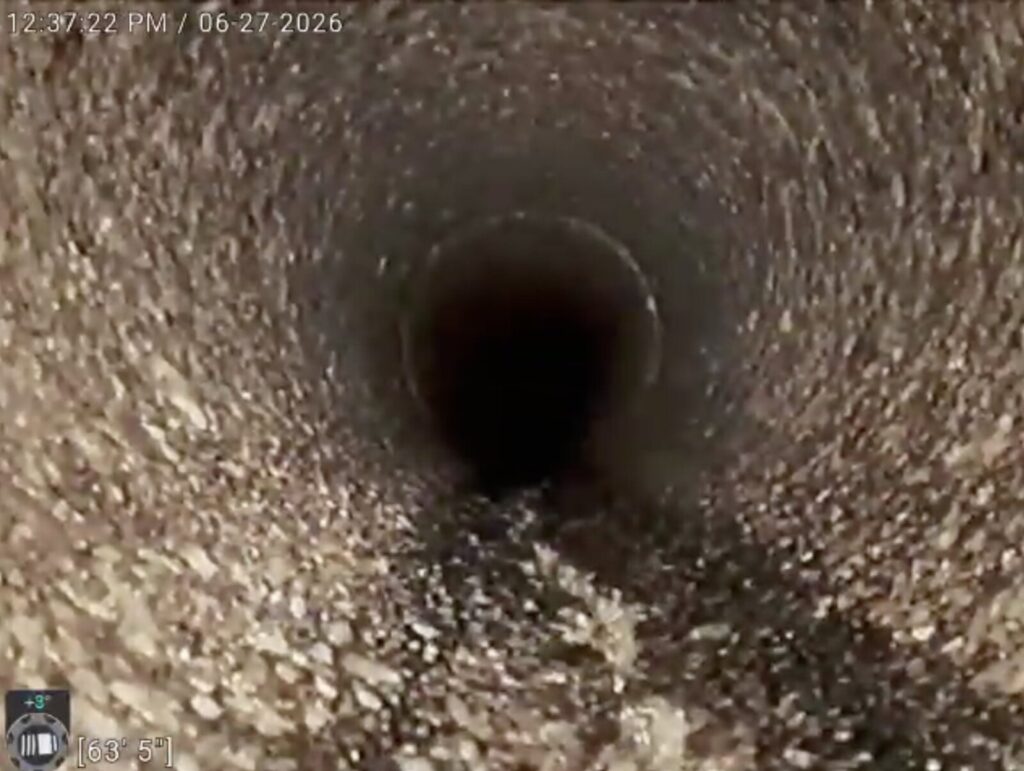
Further up this page we said a dark channel along the bottom of a cast iron pipe is usually nothing to worry about. Concrete is the pipe where the bottom going means something, and it’s the second finding on this page where we’ll tell you straight that it’s real.
We find it periodically across the metro — rarely a whole line, usually one stretch in the middle of a run that is otherwise cast iron and clay. And going back through our own inspection reports, about half the concrete lines we have scoped had something genuinely wrong with them. For every other material in those reports, the overwhelming majority come back clean and serviceable.
It is always the same failure. Concrete makes an excellent storm drain, but sanitary sewage gives off hydrogen sulfide gas, and hydrogen sulfide in a damp pipe produces a very dilute sulphuric acid. Dilute or not, it is corrosive to concrete — and the flow sits on the floor of the pipe, so that is where it works.
The bottom wears, then washes out, then holes through. In the worst ones we have filmed, the concrete is gone and only the aggregate — the stones in the mix — is left holding the shape.
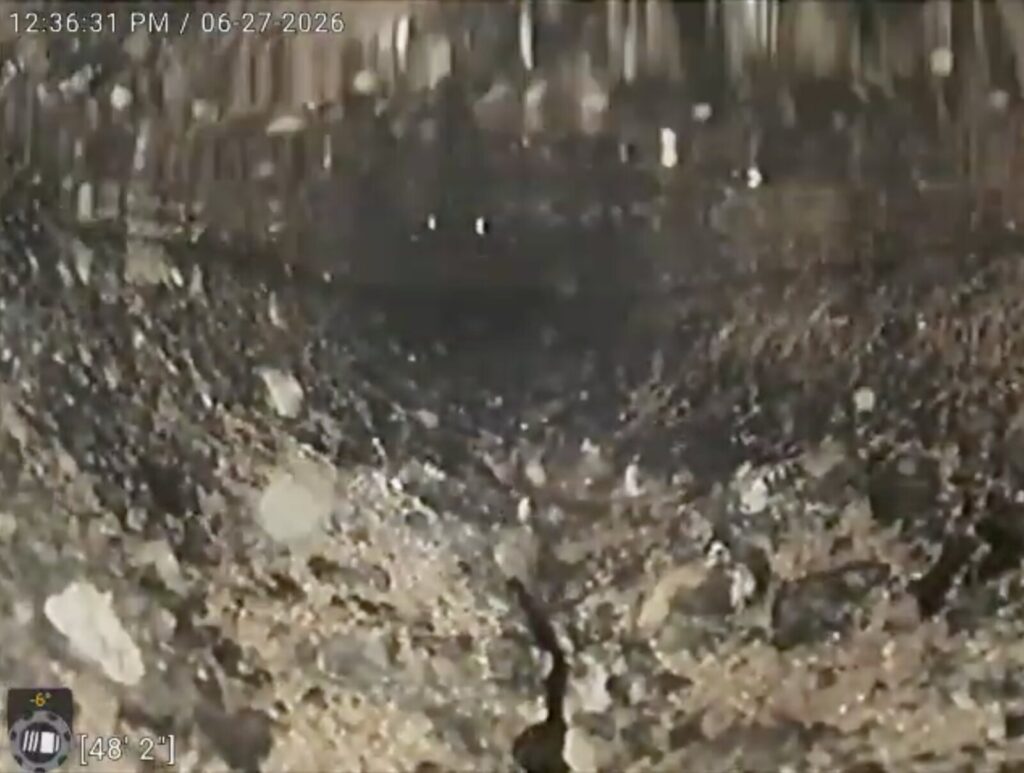
This is also the one case where a flat line genuinely matters. A belly in clay is a maintenance item. A belly in concrete, or in cast iron, is standing water sitting against a surface that water is slowly eating.
So “the bottom of the pipe is worn” in a report about concrete is not the same sentence as the same words about cast iron. It is worth looking at properly, and worth doing before it becomes a hole.
One important difference from Orangeburg, though: concrete can usually be lined. A cured-in-place liner forms a new jointless pipe inside the old one with no trench at all, which on a stretch running under a patio or a driveway is the difference between a morning’s work and a fortnight of excavation. What each repair method actually involves — from a company that performs none of them.
The footage numbers
Findings are logged by distance from where the camera went in — so “bellies from 45′ to 50′” means forty-five to fifty feet along the line from the clean-out. Useful for knowing whether something is under your basement slab or out under the lawn, which makes a large difference to what any repair would cost.
The total footage tells you how far it is to the city main. Most metro lines run somewhere between sixty and a hundred and forty feet. If a company tells you your blockage is unreachable, ask how much cable they carry — and what diameter. We run 150 feet of 11/16-inch as standard, and we’ve cleared blockages past two hundred.
Why two reports can give different footage
A sewer camera counts footage with a rotational counter on the reel. It measures how far the drum has turned, not how much pushrod has actually gone down the pipe. Wind the rod back on loosely, or let it come in a mess, and the count changes. Different camera, different reel, different number — on the same line, on the same day.
So if you are holding two reports that disagree about how far it is to the main, or about where a finding sits, neither inspector is necessarily wrong and nobody is necessarily lying to you. You are reading two drum counters. It is length along the pipe, measured by a machine that counts turns, and it is close rather than exact.
Which is why a footage figure on its own is not a place to dig. When we find a defect that has to go in a report, we don’t just write the number down. We locate it and mark it — a green flag in the lawn, or a green arrow sprayed on the concrete or the driveway. The repair company digs to the mark, and any good one verifies it with their own locator before they break ground.
The number tells you roughly where to look. The mark on the ground tells you where it is. Nobody should open your lawn on the strength of a drum counter.
The mark is not an extra. A locate comes with both of our camera services — the NASSCO inspection at $175 and the camera with locate at $145 — and when a defect is going into a report we locate it as a matter of course. The difference between the two is the written report, not the locate.
What genuinely does mean replacement
We’d rather tell you this plainly than have you think we say yes to everything:
- Orangeburg pipe
- A collapsed section — the pipe has lost its shape and the camera can’t pass
- A separated joint with soil coming in, or a visible void around the pipe
- Cast iron actually holed through, seen after cleaning
- A belly deep enough and long enough to hold solids no matter how often it’s cleaned
If that’s what you’ve got, we’ll show you on camera and point you to R.C Pipeline (303-597-8396), who do underground sewer repair and replacement. BBB accredited, A+ rated. We don’t take a referral fee — the moment money changes hands for a recommendation, the recommendation is worth nothing.
Why you can take our word for it
There’s a saying in the drain cleaning trade: if you do maintenance and repair, you cannot stay honest. We decided a long time ago to take that seriously.
We only do maintenance — cleaning, jetting, milling out scale, cutting roots and camera inspection. We don’t replace sewer lines and we don’t dig. So when we read your report and tell you it describes a line that needs cleaning rather than replacing, we aren’t turning down work. We never had it to sell.
And the fair question back is whether we’d call a line fine when it isn’t, since cleaning is what we do sell. That’s what the camera is for. We put one down every line before we start and again after we finish, and the footage is yours to keep — permanently, including the parts that argue against us.
You don’t have to take that on faith either. Here’s a customer who came to us the same way most people do — someone in the trade sent her:
“We were recommend this company by the individual who did our sewer scope. He said they are one of the more trustworthy companies in the area and he was right! We contacted them and had a quote/appointment within a few days. Ronnie and Layne who did the cleaning were professional, kind and did a great job! Would definitely recommend”
Aoife Burns — Google review
That’s the part we’d point at. The man who scoped her line had no reason to say anything about us at all — he’d already been paid, and he wasn’t going to see a penny of whatever we charged her. He sent her anyway. More of our reviews.
If you’re in the middle of a sale
A lot of these reports land during a real estate transaction, with a deadline attached and a number in the buyer’s head that came from somewhere else.
We’re NASSCO certified, so our inspection comes with a written report and video — the documentation lenders, title companies and the other side’s agent will accept. It says what’s there, whether that’s good news or bad. More than one deal has been settled by a clean post-cleaning report showing the line was never the problem.
Don’t take our word for it — look us up
Our Drain and Sewer Company is a member of NASSCO — the national trade association that writes the standards for assessing and maintaining underground pipe — and two of our technicians are certified under its building sewer and drain inspection program.
Anyone can put a certification on a website. NASSCO keeps a public directory of every person who holds one of theirs, and you can search it yourself in about thirty seconds.
Put Our Drain and Sewer Company in the Organization field and you’ll find both of us:
- Morris (Mark) Friberg — BSDI certified, June 2025
- Ronald (Ronnie) Patin — BSDI certified, June 2025
Why a year-old certification is worth mentioning
Search that directory for Denver and you’ll find plenty of certified people — engineers, and staff at the City and County of Denver. They hold the programs built for public infrastructure: mains, laterals and manholes. They’re the reason the city’s sewers get assessed properly, and none of them are coming to your basement.
BSDI is the one written for the pipe under a private house, and for real estate transactions specifically. It was published in February 2025. Before that there was no standardised training for this work at all — every company had its own way of describing what it found, which is a large part of why two inspections of the same pipe can read so differently.
Two of our three technicians are certified under it, and we were the first in the Denver metro area to hold it — certified in June 2025, nine months before anyone else in the region. You can confirm that in the directory yourself; the original certification date is on every listing.
And there’s a practical part that matters more than the certificate: the standard requires the certified person to be on site while the inspection is done. Not back at an office signing off on somebody else’s footage. On the job, running the camera, writing down what’s there.
It’s the same principle as everything else here. You can check the footage, you can check the report, and you can check us.
Bring us your report
Call Cam and send it to our email – ourdrainandsewer@gmail.com. Cam answers the phone and looks at all reports and videos to determine what is needed. Estimates are free, our prices are published, and if you’re far enough out to need a trip charge we’ll tell you before we come
Family owned and operated, and run on one rule: “do unto others as you would have them do unto you“. That’s why we’ll tell you when you don’t need the work.
Mon–Fri 8:00am–5:00pm. Free estimates across the Denver metro area.