Our business address is in Longmont, and we charge a trip charge to come here. It’s worth explaining that before anything else, because it’s the sort of thing a company usually hopes you won’t notice.
The address is real — it’s on our NASSCO listing and our BBB record. But the vans and the technicians start their day in Denver, and it is the better part of forty minutes up to Longmont proper. So a Longmont job costs us a drive that a Denver job doesn’t, and the trip charge is $50 to $100 depending on where you are. Cam tells you which before you book, not after we arrive.
We’d rather say that plainly than let you find it on the invoice. The alternative — writing “we’re local here” on the page for the town in our own address — would be the easiest sentence in the world to write and the first one you’d catch us on.
What you get for the drive is the same as everywhere else: cabling, hydro jetting, carbide milling for cast iron, root cutting, and NASSCO certified camera inspection with a written report. We don’t do repairs and we don’t dig.
Five Longmont lines, five different pipes, no repairs
Every Longmont line we have put a camera down has come back clean and serviceable. Not one has needed a repair — and they are not similar lines.
Between them those five houses have ABS, PVC, SDR35, cast iron, vitrified clay, asbestos cement and copper in the ground, in almost every combination. Longmont built over a long stretch of time and it shows underneath.
If your report says copper, read this before you worry
One Longmont line runs PVC from the clean-out, then copper for twenty-odd feet, then cast iron through the foundation, then clay out to the tap.
Copper is not a buried-pipe material. Where you normally find it is the vent stack — running vertically, carrying air rather than flow. Finding it horizontal, in the drain line itself, is unusual enough that an inspector who doesn’t work on these every day may well flag it.
On that house it was fine, and the reason is where it sits: that stretch runs through the open air of the crawl space rather than through soil. Copper in air is a different proposition from copper in the ground. The plumber who put it there knew what he was doing.
That is the whole job, really — knowing which unusual things are a problem and which are somebody having solved something properly forty years ago.
The two hundred and fifty foot line
The longest sewer line we have filmed in the metro area is in Longmont. Two hundred and fifty feet from the outside clean-out to the city tap, where most metro lines run between sixty and a hundred and forty.
It is not in good condition, either. The camera found a break at forty-one feet, two long bellies, two patches from previous maintenance, and what looks like two other houses tied into the same run further down.
Here is what went in the report:
“This line will work fine as long as it is not abused… No Charmin, Tampons, Pads, Paper Towels, Tissues, Grease, or large amounts of food.”
Not a replacement quote. A list of what not to put down it.
That line is also right at the edge of what a cable can physically reach. We carry two hundred and fifty feet of 11/16-inch, and past about two hundred and seventy-five the cable stops being controllable — the torque flips it and it ties itself in a knot inside your pipe. So on a run like that one, the jetter isn’t the upgrade. It’s the only tool that gets to the far end at all, and we carry five hundred feet of hose for exactly this reason.
If you have been told your line is too long to clean, that is a statement about somebody’s equipment rather than about your pipe.
Bellies, and the number that settles them
Three of the five Longmont reports found a belly, and all three said the same thing: not a problem.
One holds three-quarters of an inch of water over three feet. One holds an inch and a half and ends at the city tap. One house has two of them. None of them is impeding flow or collecting debris, and none of them is a reason to dig up a garden.
We don’t recommend repairing a belly until it is over twenty feet long and holding more than two inches — half the pipe. That number is written into our reports, so you can hold us to it. Where that number comes from.
The van is set up to finish the job
On that same copper-and-clay line, a hundred and eleven feet in, the camera battery died. It’s in the report, in those words, because everything that happened on the job goes in the report.
What isn’t in the report is that it didn’t cost the customer anything. The vans carry a 120-volt adapter for the camera, and an inverter wired to the van’s battery so the camera packs charge while we drive. We went back in from the other end and finished the line the same afternoon — the report shows both runs and full coverage of all one hundred and thirty-nine feet.
Equipment runs out of power. The question is whether the van was built on the assumption that it would.
A Longmont customer, 2019
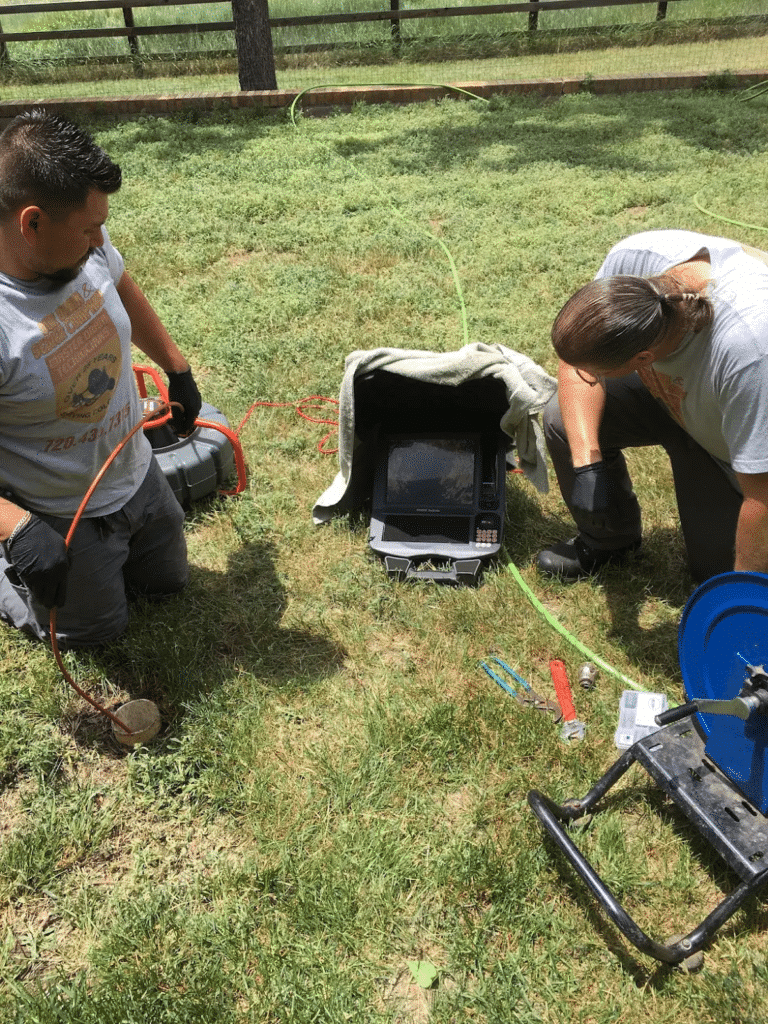
“Great company! If you have sewer line issues call them. Mark and Miguel were excellent. Friendly, thorough and very experienced. They saved me thousands with their advice. They have all the latest technology needed to diagnose a problem. The picture you see here is Miguel placing a camera in the sewer line to see the extent of the problem. I will recommend them to others in the future!”
Greg Hoffman — Google review, June 2019
They saved me thousands with their advice — advice, not work. That is the shape of most of what we do here.
If you’re holding a report
Send it to us before you agree to anything. Call Cam on (720) 435-7315 or email ourdrainandsewer@gmail.com with the report and the video link — she reads every report and watches every video before anything gets quoted.
If you want to know what the words in it mean first, we’ve written all of them down. And if the report says the line genuinely needs work, here’s what each repair method actually involves — from a company that performs none of them.
What it costs in Longmont
- Mainline sewer cleaning from an accessible clean-out, up to an hour, 150 feet of cable — $225
- Clogged drains and sinks, up to an hour, 75 feet of cable — $175
- NASSCO certified camera inspection, video and written report — $175
- Camera with locate, video — $145
- Carbide flex-shaft milling and cast iron restoration, up to two hours — $475
- Trailer-mounted hydro jetting, up to two hours, 500 feet of hose — $475
- Trip charge to Longmont — $50 to $100 depending on where you are. Quoted before you book.
Estimates are free and the full price list is published. We book about a week out, and by Friday most of the following week is usually gone.